
Quick answer: use EDDM when most households in a neighborhood could plausibly buy from you (restaurants, home services, dental, retail); use a targeted mailing list when your buyer is defined by data instead of geography (income, home value, industry, life event). EDDM postage is a flat $0.247 per piece with no list to buy; targeted mail costs more per piece but wastes none of them. Below are 10 real use cases and which method wins each one.
Last updated: June 2026. Postage figures from USPS Notice 123, effective April 26, 2026; USPS has a rate change scheduled for July 12, 2026, so verify before you mail.
The 30-Second Rule of Thumb
Every direct mail campaign answers one question first: is your customer an address or a person? If the address is enough (everyone at this house eats pizza, owns this roof, has teeth), saturation wins on price and EDDM is the cheapest saturation there is. If you need the person to match a profile (income over $150k, owns a pool, just moved in, runs a dental office), you need a list. Here is the whole decision as a flowchart:
$0.247/piece postage, no list, whole routes
addressed mail, zero waste
That is the short version. Below: the full side-by-side mechanics, the cost math, the same budget worked both ways, and 10 real use cases with a verdict for each. When you are ready to run one, our EDDM service and targeted mailing list pages cover the ordering side.
The Full Side-by-Side Comparison
First, the vocabulary trap: "direct mail" is the umbrella term, and EDDM is one kind of it. The real comparison is between USPS Every Door Direct Mail and an addressed campaign built on a mailing list. Here is every difference that matters, in one table:
| EDDM | Targeted direct mail (list) | |
|---|---|---|
| Postage | Flat $0.247/piece (Retail), any qualifying size | From $0.365 (Marketing Mail) to $0.420+ (First-Class presort) |
| Mailing list | None. List cost: $0 | Required; licensed per record, priced by your filters |
| Addressing | Generic "Local Postal Customer" block | Name and street address on every piece |
| Targeting unit | Whole carrier routes, all-or-nothing | Individual households or businesses |
| Demographics | Route-level Census averages: income, age band, household size | Household-level filters: income, home value, owner/renter, new movers, industry, and more |
| Personalization | None; every door gets the identical piece | Variable data: names, offers, images per recipient |
| Size rules | Must be a USPS flat; standard 4" × 6" and 6" × 9" postcards do not qualify (size rules) | Any mailable format, including small postcards and letters |
| Permit | None needed at Retail (Retail vs. BMEU) | Runs under a Marketing Mail permit; we provide ours |
| Volume rules | 200 to 5,000 pieces per ZIP per day at Retail | 200-piece minimum, no daily cap |
| Forwarding | No; pieces go to the route's current addresses only | First-Class pieces forward to movers and return if undeliverable |
| Exclusions | Cannot skip or include anyone by name (targeting limits) | Suppress existing customers, target only past ones, or anything in between |
| Best for | Neighborhood saturation: restaurants, home services, dental, retail, real estate farming | Profile-defined buyers: high-value homes, B2B, new movers, reactivation |
The Cost Math Behind the Choice
Postage sets the floor for every campaign, and the gap between methods is real money at volume. Current per-piece postage, from the USPS Notice 123 price list:
Two things the chart hides. First, targeted mail adds a list cost on top of postage, while EDDM has none; we run list counts and searches free, so at Catdi Printing the data work costs you nothing to scope. Second, postage on addressed Marketing Mail drops as your addresses cluster more densely per carrier route, which is the same economics that make EDDM cheap. The full breakdown lives in the direct mail cost chapter of this guide.
The Same $1,500 Postage Budget, Two Ways
Numbers make the trade-off concrete. Give the same postage budget to both methods (printing priced separately) and watch what each one buys:
| EDDM saturation | Targeted list | |
|---|---|---|
| Postage rate | $0.247/piece | $0.420/piece (First-Class presort) |
| Pieces mailed | ~6,000 | ~3,500 |
| List cost on top | $0 | Per-record licensing |
| Who receives it | Every door on the chosen routes | Only households matching your filters |
Now apply your customer density. If one door in two on those routes is a plausible customer, EDDM put the piece in front of ~3,000 real prospects against the list's 3,500, with zero list cost: close to a tie, and the simpler program wins it. If one door in twenty qualifies, EDDM reached ~300 prospects and the targeted list beats it several times over before you even count the wasted print. That density question is the entire decision, and the use cases below are just that question wearing ten different uniforms.
5 Use Cases Where EDDM Wins
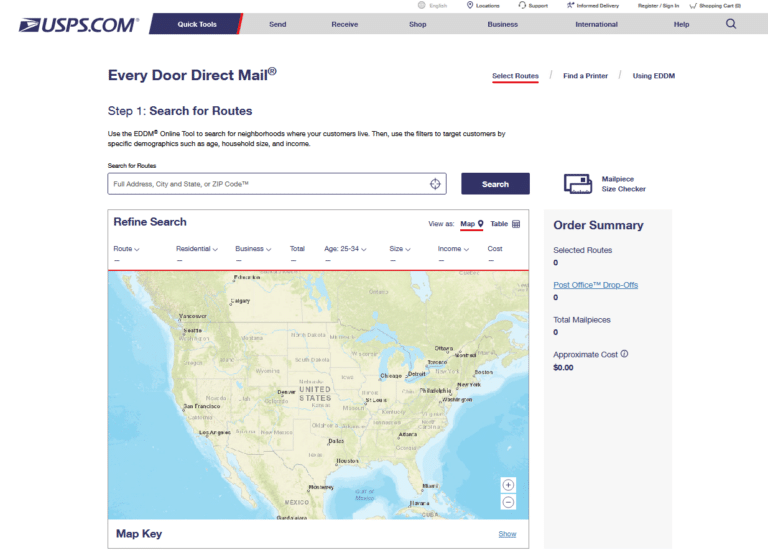
- The new pizza shop launch. Every door within two miles eats. A grand-opening menu to 4,000 nearby doors costs $988 in postage (4,000 × $0.247), no list required, and the menu has fridge staying power. This is the textbook case from our business fit test.
- The roofer after a hailstorm. The storm did the targeting for you: every roof on those streets took the same hail. Saturate the affected routes the week after, while adjusters are still in the neighborhood.
- The dental practice filling new-patient slots. Patients pick providers close to home, and nearly every household has teeth to clean. Pick the family-heavy routes with the route demographics (household size 2.5+, age band set to young families) and mail an offer with a deadline.
- The gym in January. Resolution season is a geography play: everyone within drive time is a prospect for exactly six weeks. Three waves on the same close-in routes beat one big blast; cadence math is in our frequency chapter.
- The real estate agent farming a subdivision. Farming is name recognition on every door, not precision. A monthly just-listed/just-sold card to the same 1,500 homes runs about $371 a month in postage and builds the only thing that wins listings: familiarity.
5 Use Cases Where a Targeted List Wins

- The pool builder. Maybe 350 homes across four ZIP codes have both the lot size and the home value for a $70k pool. EDDM would mail 30,000 doors to reach them; a property-data list filtered on home value and lot size mails 350.
- The luxury remodeler. "Homeowners, $500k+ home value, owned 7+ years" is a list filter, not a neighborhood. Even at First-Class presort postage ($0.420), mailing 1,200 right households costs $504 in postage versus $1,482 to saturate 6,000 mixed doors.
- The B2B supplier. Offices, not households. Business lists filter by industry code, employee count, and revenue; EDDM cannot separate a dentist's office from the nail salon next door.
- The new-mover welcome offer. New residents pick their dry cleaner, vet, and dentist in the first 90 days. New-mover lists refresh monthly and reach only them, with personalized addressing that EDDM's "Local Postal Customer" block cannot do.
- The reactivation campaign. Your best list is the customers you already have. Mailing your house list with a we-miss-you offer wastes zero pieces, and EDDM physically cannot exclude or include anyone by name.
Not sure which side your campaign lands on? Tell us the customer and we will run the numbers both ways at no charge: free list counts for the targeted version, free route map and postage estimate for the EDDM version. Postage is always a pass-through at Catdi Printing; you pay exactly what USPS charges. Start a quote or call (713) 882-4629.
The Hybrid Play: When the Answer Is Both
The strongest local campaigns we print often split the budget: EDDM saturates the tight radius around the business where everyone is a prospect, and a targeted list reaches the high-value outliers beyond it. Same artwork, two postage strategies, one campaign. A med spa might saturate the three routes around the location and add a filtered list of higher-income households up to twenty minutes out. We build these as one job so timing and print panels line up.
All 10 Use Cases at a Glance
| Use case | Winner | Why |
|---|---|---|
| New restaurant launch | EDDM | Everyone nearby eats; menus keep working from the fridge |
| Roofer after a storm | EDDM | The storm targeted the neighborhood for you |
| Dental new-patient push | EDDM | Proximity decides; route demographics refine |
| Gym in January | EDDM | Drive-time radius, repeated waves |
| Real estate farming | EDDM | Name recognition on every door, monthly |
| Pool builder | Targeted | 350 qualified homes hiding among 30,000 doors |
| Luxury remodeler | Targeted | Home value and tenure are list filters |
| B2B supplier | Targeted | Industry and company-size filters; EDDM can't isolate businesses |
| New-mover offers | Targeted | Monthly-refreshed mover lists, personalized |
| Customer reactivation | Targeted | Your house list; zero waste |
EDDM vs. Targeted Mail FAQ
What is the difference between EDDM and regular direct mail?
Addressing. EDDM has no mailing list and no names; you pick carrier routes and every active address on them gets the piece, at the lowest postage USPS sells. "Regular" (targeted) direct mail uses a list of named recipients, costs more per piece, and reaches exactly the households or businesses you choose. Everything else, from size rules to permits, flows from that one difference.
Is EDDM considered direct mail?
Yes. EDDM is a type of direct mail; specifically, it is USPS's retail-friendly version of saturation Marketing Mail. When marketers say "EDDM vs. direct mail" they almost always mean EDDM vs. an addressed, list-based campaign, which is the comparison this page covers.
Which gets a better response rate, EDDM or targeted mail?
Per piece, a well-filtered targeted list usually responds at a higher rate, because every recipient matches the buyer profile. Per dollar, EDDM often wins in dense-fit neighborhoods because each contact costs so much less. The honest metric is cost per response, and it depends on your offer and your customer density far more than on the mailing method; we would rather run the math for your case than quote an industry average.
Can EDDM target by income or age?
Only at the route level. The USPS tool shows average household income, age bands, and household size per carrier route, so you can pick better routes, but every door on a chosen route gets the piece. Household-level filters require a list; the line between the two is drawn precisely in our targeting limits guide.
Is targeted mail always more expensive?
Per piece, yes: higher postage plus list licensing. Per customer reached, often no. When fewer than one door in ten could buy from you, paying more per piece to mail only qualified households is the cheaper campaign.
What are the minimums for each?
EDDM Retail requires at least 200 pieces per ZIP and allows up to 5,000 per ZIP per day. Targeted mailings have no USPS minimum that small businesses typically hit; list pricing makes very small runs less efficient, which is one more thing a free itemized quote sorts out.
Can I run EDDM and a targeted list in the same campaign?
Yes, and it is often the right answer: saturate the close-in routes with EDDM and reach distant high-value prospects with a list, using the same artwork. We coordinate both drops as one job.
How do I get a mailing list without buying blind?
Start with counts, not a purchase. We run free list counts against your filters (geography, income, home value, industry) so you see exactly how many mailable prospects exist before spending anything.
Get the Numbers for Your Exact Situation
Bring us the business and the goal, and we will price the EDDM version, the targeted version, and the hybrid, itemized line by line with postage at USPS cost. Explore our EDDM service, see targeted mailing lists, request a quote, or call (713) 882-4629 and talk through your use case with a Houston print rep.